
Generations
A demographic primer on culture, the economy, and social change.

The stupid and the senseless alike perish
And leave their wealth to others.
Their inner thought is that their houses are forever
And their dwelling places to all generations;
They have called their lands after their own names.
But man in his pomp will not endure;
He is like the beasts…
—Psalm 49:10-12
A New Year
Welcome 2026 to all who celebrate the existence of years!
So far the lawless are still lawless, the murderers murderous, fools foolish, and the lists listless, but the mere numeration of a year wouldn’t change that, would it?
We Joneses saw in the New Year at home. Jen and Ellie had to wake me up at 11:50—I had fallen asleep on the couch—for the countdown with the televised Ryan Seacrest-hosted Time Square Ball Drop, the very broadcast that had put me to sleep half an hour earlier. Then we danced around a bit, and I went back to sleep.
For Jen and I this was similar to our last ten New Years. Since we married, bore a delightful daughter, and ran out of the urge to drink, New Years are just another trip around the sun, but for that delightful daughter ten years is a huge difference. Now that she is 14 New Years isn’t like when she was 4 at all.
Today I want to dig into that reality a little with a basic primer on age cohorts, demographics, and generations. This will be very useful for the stories we’ll be telling this year at Blame Cannon.
Rock you like a hurricane
In August, 1969 central Virginia was hit by Hurricane Camille, one of the most famous and devastating weather events in the state’s history. Camille made landfall in Mississippi and weakened as it moved inland. But crossing the Appalachians it refueled, and reaching Virginia unloaded Old Testament levels of water:
In Nelson county, one location reported a whopping 27" of rain in only eight hours. This caused 133 bridges to be wiped out throughout Nelson county.
In Scottsville the James River rose 31.5’. Nearby Howardsville almost ceased to exist. Hollows were buried in landslides, town centers buried in rivers, and countless homes washed away. With phone lines down, roads flooded, and bridges gone all over the western half of the state communication and transportation stopped. Emergency services couldn’t operate.
At least 153 people died in the catastrophe.


My mom remembers Camille vividly. From time to time when we drove on 29 South through Nelson County she would describe the intensity of the storm, the fear everyone felt, and the destruction it caused.
Yet my mom was never really part of that suffering directly. She was living in an apartment complex on Barracks Road during the storm, a single mom of my brother Bret and I. She had plenty of challenges in life before and after Camille, but being threatened directly by the hurricane was not one of them. This is a critical element of human psychology. She wasn’t bragging. But as a young mother responsible for two young children she could not help but fear that the roof of the apartment complex might have blown off or caved in. Should could easily imagine having rented an apartment somewhere else on lower ground, or having found a job or apartment in Scottsville or Howardsville. As a young adult she thought of things this way and Hurricane Camille became a “core memory”—as my daughter would put it—because it was something she went through that could have affected her physically, financially, mortally even though it didn’t.
My daughter also says—and she made this up herself so credit “that Substack guy’s daughter” when you use it yourself—
One person’s core memory is another person’s Monday.
Bret and I were theoretically just as impacted by Hurricane Camille—which is to say, we were in the storm and if our life’s circumstances or the storms course had changed we could have lost our homes, or even died.
Yet I have no memory of Camille at all. It’s still filed in my mind as an important event that I will never forget, but it’s not an event I personally remember.
Bret was 6 while I was 4, so Bret vaguely remembers it, but I’m not sure he’s sure what he remembers versus what he’s imagined from assuming he should remember. Whether his memories are real or not, his age gives him a different relationship to it. Even if we had been in Scottsville, which flooded completely, I probably would not have any memory of Hurricane Camille unless there was a direct trauma event like watching my mom drown or seeing the roof cave in, but if we had been in Scottsville, Bret would have been old enough to have much stronger memories of the storm.
Thus we see that any event is going to be experienced and remembered differently by…
young adults responsible for children
children old enough to understand what’s going on but not old enough to be responsible
children too young to remember much of anything but who know the event is important because they hear older people talking about it.
To flesh this out further, during Hurricane Camille there were older adults who had lived in Central Virginia long enough to have lived through Tropical Storm Gracie, Hurricane Hazel, and maybe even the 1937 Danville Flood. They would experienced Hurricane Camille differently. They could see it for its destructiveness, particularly compared to previous storms, but they would have the confidence of knowing they would find a way through it, and they wouldn’t feel directly responsible for the safety of young children. So let’s add in:
older adults who have been through similar events before and tend to be in leadership roles.
Finally, let’s add a final age cohort (a group of people of the same age) who are born later still, such as my younger brother, Ben, who was born late enough I’m not sure my mom was still telling the Camille stories at all:
children born so late that the event is not talked about enough for the event to feel important.
Whether it’s a hurricane, a town fire, a riot, or an epidemic, local or national, happy or sad, events will be experienced differently by different age groups. Everywhere in the world—mountain village or coastal tourist town, Bronze Age or early industrial England—different age cohorts will carry an event differently depending on their age when it happened, and for a culture this matters more than how close they were or how personally affected. A Nelson County young adult whose house was flooded will have experienced Camille very differently than a young adult whose house was not flooded, as a soldier in combat who is wounded experiences the war differently than a fellow soldier in the same unit who was not wounded, but both carry a shared war in their consciousness very differently than those who only hear about the war.
Which brings us to our first rule of generations: (We’ll summarize them at the bottom for quick future reference.)
PEOPLE EXPERIENCE EVENTS DIFFERENTLY DEPENDING ON THEIR AGE AT THE TIME OF THE EVENT.
As Hurricane Camille was in Central Virginia so WWII was for the United States as a whole, only more so because it lasted longer. It was a different event for different age groups.
For soldiers and sailors who had served during WWI and politicians who were young adults during that WWI, WWII was a bigger, longer, more complicated version of war.
For younger adults WWII was something like my mother’s experience of Camille. This includes the 15% or so of enlisted soldiers and sailors who experienced combat, the 85% soldiers and sailors who didn’t, and even for the men and women of the same age cohort who never joined any branch of the armed forces. WWII was a defining event. Even those young adults who didn’t serve spent much of the war thinking about the war. It was fundamental to their consciousness that if circumstances were different they would have been there.
For those born old enough to know the war was going on but not yet adults WWII was something like my brother’s experience of Hurricane Camille.
For those born too late to really understand anything about the war, WWII was something like my understanding of Hurricane Camille, an archetype, but not one personally experienced.
For those born twenty years after WWII, WWII became something like my brother’s relationship to Hurricane Camille, something that was only of historical interest.
These age cohorts sharing similar experiences made up the basic generations at the center of the 20th Century: Lost, G.I., Silent, Boomer, and Xer.
Vertical versus Horizontal Integration
Our second rule of generations has to do with how humans situate themselves with regard to their friends, family, and neighbors; how much time people spend with their own age cohort or generation versus with people of different age cohorts such as parents, grandparents, and children.
In vertically-integrated cultures people spend more of their time with older and younger members of the same family, clan, town, or profession rather than with a group of people their own age. Their emotional connections and public reputations are more oriented towards older and younger people.
In horizontally-integrated cultures (like ours) people spend more of their time with others of their same age than with older and younger people. Their emotional connections and public reputations are more oriented towards their friends and siblings.
Let’s compare a male teenager in 1725 Philadelphia versus a male teenager in 2025 Philadelphia.
Our colonial teenager grew up on a family where as a teen he was apprenticed to some craft. He would receive room and board and learn the trade with the master craftsman in the master’s household while laboring for free. So he now spends most of each day working in the shop with another apprentice or two, plus a journeyman (a wage laborer) or two, and the master who owns the shop. The master’s family probably include children of various ages. This teen will be vertically-integrated. What he knows about life, death, love, sex, art, music, marriage, babies, jobs, and self-respect will as likely come from his master, mistress, admired journeymen, or his own distant father back home than with others his own age, and even his emotional bonds are as likely with journeymen, the master, mistress, or the master’s younger children, than with the limited number of other teenagers he knows.
Our contemporary teenager grew up in a family where he was probably sent to daycare from the age of 4 and then to kindergarten and then to public school. From his first day in daycare or school, the majority of his waking hours for much of the year he spends in rooms that are organized by chronological age, with one or two supervising adults for between 6 and 30 kids. This kid will be horizontally-integrated. What he knows about life, death, love, sex, art, music, marriage, babies, jobs, and self-respect will as likely come from his friends (or enemies) at school, and while he may have a few emotional bonds with parents, siblings, or a trusted teacher or coach, most of his emotional bonds are with other teenagers he knows.
Neither type of culture is necessarily better than the other, but it’s important to realize how radically different they are. More than geography, spelling, or math, mass public education—not a criticism, just a fact—teaches Americans to build culture and community with those of more or less the same age. Preschools might mix ages a bit. High school students mix with kids a year or two older or younger, maybe three years young. Kids who go to college will continue the high school pattern. But this means 18 of an American’s first 21 years are often spent with basically the same age cohort.
The difference is not about feeling. A vertically-integrated person my detest his dad while a horizontally-integrated person might idolize family; the difference is how much actual time do people spend with their own age group versus other age groups.
This brings us to our second rule:
MOST HUMAN CULTURES ARE VERTICALLY-INTEGRATED, BUT SOME CULTURES, USUALLY DUE TO MASS EDUCATION AND/OR MASS MILITARY SERVICE, BECOME HORIZONTALLY-INTEGRATED.
When Yannis Comes Marching Home Again
Mass public education segregates people by age to form a culture with one another, and before this industrial manufacturers often segregated people in this way as well—and much later in some countries housing will have an impact—but there is one situation that has from time to time horizontally-integrated men (and possibly for women indirectly) long before mass education, industrialization, or the suburbs could even be dreamed of—and that was mass infantry warfare.
According to legend a certain King Pheidon of Argos around 670 BC changed the straps on infantry shields so it didn’t take as much strength to hold one, and more importantly instead of each shield protecting the soldier holding it, the Argive shields protected half of that soldier and half of the soldier next to him. So these infantry—hoplites as the Greeks called them—needed to press into their neighbor’s shield to protect their exposed half, while their neighbor on the other side pressed into their shield.
This caused troops advanced toward an enemy to tighten their lines into a deadly, spear-bristling rugby scrum. Troops of Argos using this system beat all comers until the other Greek cities followed suit. Across the Greek world infantry learned that if they trusted one another cavalry, chariots, slingers and archers could do little against their walls of shields. Only the a more disciplined, larger, or luckier block of enemy infantry were a threat. Ironically most historians believe the dominance of this new armored citizen infantry played a role in the seizure of political power from the kings like Pheidon and his ilk and the institution of democracies.1
Hoplite warfare meant that in the city-states of Greece most military-age men were separated for long periods from children, women of their own age, and the older generations. These young and middle-aged men formed their own intense horizontally-integrated subcultures and this created the culture of Archaic and Classical Greece.
WWII in America had the same effect but more so. It was a sort of triple-whammy of horizontal integration, adding on top of the effects of 20th century industrialization and universal public education, a huge contingent of men going off to serve in the army, navy, and marines. They came back very different.
WWI had a similar impact in Great Britain, particularly among the upper class boys who were educated at boarding schools and went to serve as officers in British Expeditionary Force. I highly recommend Paul Fussell’s The Great War and Modern Memory, which tracks the pervasive effects on British culture of the return of an age cohort raised in mass education and exposed to mass military service.
For Brits after WWI and Americans after WWII soldiers and sailors came home no longer willing to abide by the older rules for language, sex, clothing, or anything else. Instead they made the rules with one another and copied one another. While young people in the “Sixties” in America tend to have the reputation for loosening social rules—and that is indeed when the loosened rules hit the mainstream—authors, musicians, and poets from WWII were breaking the rules first, as WWI authors, musicians, and poets had done before. In all cases however it’s more the case that vertical rules were replaced with horizontal rules. Each age cohort still expected conformity but conformity to rules of the age cohort.
Vertically-integrated societies have taboos against explicit sexuality, vulgar language, and even casual clothing because everyone is in the same room. Songs and stories have to be suitable for all ages—and not the Disney “all ages” meaning “suitable for children”.
A traditional Irish folk tale told by an old lady in a village on a Western Islands had to entertain the kids and the adults in the same room. That would usually mean more sex and violence for the kids than a modern parent wants their children exposed to, but less sex and violence than those same parents might imbibe on Netflix after the kids are in bed. A Martin McDonagh movie set on a Western Island is age-specific. It would be scary for young kids and boring for teens, but adults might love it. The folk tale is vertically-integrated. The movie is horizontally-integrated.
Age cohorts in horizontally-integrated societies often gleefully violate taboos of older or younger cohorts (who aren’t around anyway) while imposing taboos of their own. Think how an aging Boomer remembers shocking the oldsters (who were probably more irritated than shocked) while being irritated by the cultural output of Millennials (who are think the Boomers are shocked).
In horizontally-integrated societies songs and stories are directed at particular age cohorts—this one is for children, that one is for the young, that one is for the old people. There’s the Disney movie and there’s R-rated movie. In vertically-integrated societies songs and stories—think Grimm’s fairy tales—try to be one size fits all.
Neither is better or worse, but horizontal-integration is much rarer. Most foraging bands did not have enough people in any age group to really form age-based identities. Most pastoralists, horticultural tribes, or peasant villages do not spend much of their lives in age-specific groups. In many cultures—think Shakespeare’s version of Verona where Mercutio and his friends are hanging out in the streets—young men might form a gang of sorts during their teenage years, but even here the gang was based on a particular family, and those groups dissolve as soon as marriages happen.
Something like an American class reunion, with people in a very narrow age strata meet together after not seeing each other for twenty years, would be bizarre in most cultures. Why would only people of those age groups want to meet?
Vertical versus horizontal integration probably makes a big difference in psychological health and family happiness,2 but for our purposes the main difference is our third rule. Horizontally-integrated cultures can be creatively adaptive in good ways (because they aren’t wedded to the past or future) or be grotesquely dysfunctional in bad ways (because they know little about the past or future), but in either case they can change quickly.
VERTICALLY-INTEGRATED SOCIETIES TEND TO PRESERVE CUSTOMS THROUGH GENERATIONS. HORIZONTALLY-INTEGRATED SOCIETIES CAN CHANGE CUSTOMS VERY QUICKLY.
This is because while the vertically-integrated people are psychologically bound to elders and youngsters, horizontally-integrated people are in an intense feedback loop with those of similar age and life-experience.
America in the decades after WWII was a quadruple-whammy of horizontal integration—factories, schools, suburbanization,3 and a mass draft—which is why the 20th century seems so culturally striated decade by decade than periods before or after.
Seasons they go round and round
Our fourth rule of generations is simple and obvious, but it has massive repercussions when we put all this together:
PEOPLE SPEND TIME AND MONEY DIFFERENTLY AT DIFFERENT STAGES IN THEIR LIVES.
Of course there are exceptions, but generally…
People in their twenties and thirties are moving more, changing their living situation more, getting married, having children, so they’re spending a lot of money on furniture, appliances, clothing (especially for their children), baby stuff, repainting rooms, swapping the baby stuff for the toddler stuff. This is a period when people are starting their careers so their incomes are limited, while they may have college debt, and if they were born early enough to experience a housing market some may take on mortgages.
People in their forties and fifties are still paying lots for stuff, but their debts might be under control and their income is peaking.
People in their sixties and seventies, except for a few enthusiasts, aren’t spending much on houses, furnishings, or kids. If they are middle-class or upper middle-class contemporary Americans this is when they have prime investment money, and will support causes, new ventures, and favorite organizations.
People in their eighties or earlier if they have a health scare reverse course. They stop investing and start counting how much they need to live and maybe pass on money to heirs.
Of course these are huge generalizations. Stories vary by class, income, and the financial situation of the time and place.
Bulges in the Python
One more rule, but it’s a doozy:
DIFFERENT NUMBERS OF PEOPLE ARE BORN AT DIFFERENT TIMES.
While the overall population of the world has been increasing since the middle ages, it’s far less steady year by year in individual countries.
Here are births by year for the U.S.:
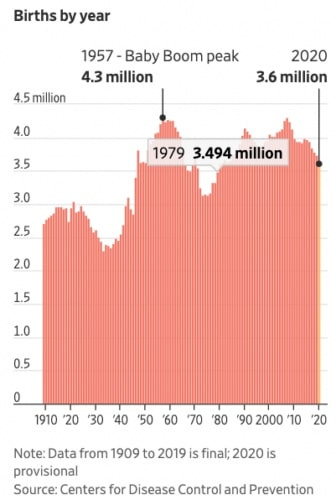
Why? Well, most variations are hard to predict but there are a couple that are not: Families put off having children during wars and then when the war is over and the soldiers come home the families make up for lost time by having lots of children. That’s a baby boom. It’s usually quite sharp but limited, a distinct blip that comes and goes. Such as in the WWI portion of the chart above. In 1918 during WWI births dipped for a year and then after the war births spiked for two years. Then the spike was over. Some wars in some places, like WWII in Eastern Europe, can kill so many people that the population is affected by the death itself, but that hasn’t happened in America in the last couple of centuries.4
There’s another predictable variation too: Families put off having children during economic downturns and when economic situations improve they make up for lost time.
So for the U.S. after WWII there was a sort of double boom. After WWII families were making up for lost time for both the Depression and the war.
That happened across the Western world, and in most of the West the post-war baby booms peaked in the 2.5 to 2.85 range (In the UK, France, and Germany peaked in 1965 at a birth rate of 2.81, 2.85, and 2.53 per woman respectively.) when families moved out of rural areas into cities where there were more opportunities, and here’s another predictable pattern: Middle class people in cities tend to have fewer children.
However, unlike Europe the U.S. built massive suburban housing tracts through government loans and sold through government-devised long-term mortgages, so families had a third housing choice beyond city vs. country. They could move to these new suburbs with a bit more room for children.5 The U.S. birth rate peaked earlier than Europe, in 1960 (probably because its citizens were richer and didn’t have to delay gratification), but at a much higher r3.58 births per woman.
The result was the U.S. baby boom was larger.6
There were 2.2 million babies born in 1938.
There were 3.5 million babies born in 1948.
There were 4.2 million babies born in 1958.
There were 3.5 million babies born in 1968.
That’s a huge variation over forty years, and remember that people spend money differently at different points in life, so that has an incredible impact on the economy.
Say, you’re selling baby food in the 1950s. You might brag to your schmuck brother about how successful you are compared to the record store he owns. Then in the mid-60s, for reasons you can’t figure out, your baby food isn’t selling, and your brother suddenly has kids lined up around the block! How could that happen?! It happened because the baby boom doesn’t stay a baby boom but becomes a toddler boom and then an elementary school boom and then a teenager boom and then a young adult boom and so on, like a giant mammal passing through the body of the python that swallowed it. At each stage the products that fly off the shelf will change, all of which will be breathlessly reported in the media looking to sell newspaper, magazines, and television ratings by discussing trends—often without awareness of demography. I recently watched a documentary about Tower Records that offered no explanation for why record sales fell except to cite the moral choices of the company managers or the changes in technology.
Any discussion of consumer products, housing, military recruiting, investment money, elite college wait lists, automobile loans, movie attendance, or almost anything else needs to take into account that different numbers of people are born in different years, and people spend money differently depending on their age.
Below is a chart showing how many of each age were alive on 12/1/23:
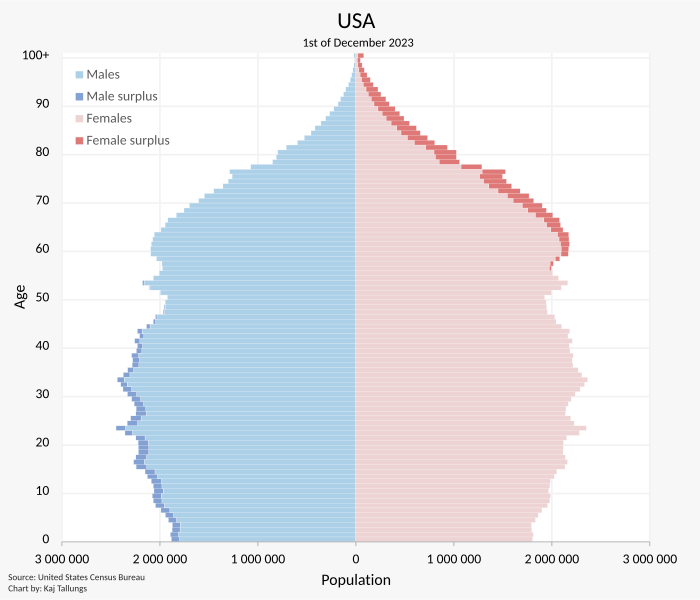
Males are blue and females are pink, and the dark blue and dark pink represent in each year whether there are more women or men. Note there are more men than women in the under 40s and more women than men in the over 60s. This is another demographic rule—most cultures have more young men than young women and more old women than old men. But we’ll take that up in some future post.
Notice how those 4.2 million babies born in 1958 and the entire demographic boom of that period has shrunk considerably as members die off year by year, auto accidents, diseases—“death by despair”.
Generations
As we said above the axis around which twentieth-century American generations have spun has been WWII.
Let’s meet the generations:
Lost Generation.
People born in the couple of decades before 1900 played a pivotal leadership role during the Depression, WWII, and the early postwar era. Truman, Eisenhower, and I would say FDR. I’ll note A. Philip Randolph of the Brotherhood of Sleeping Car Porters as the sort of Lost Generation figure who impacted the later Civil Rights movement. Lost Generation figures from the arts include Hemingway, Faulkner, and Fitzgerald, Cole Porter, Duke Ellington, and the Gershwins.
G.I. Generation.
Men born in the first couple of decades of the 20th century served as enlisted and junior officers in WWII and went on to be the political leadership of much of the postwar era. Kennedy, Nixon, Ford, Carter, Reagan, and Bush I were all WWII veterans. After the war this was the generation that moved to the suburbs, and because of the war this generation was in many senses more rigid in gender roles than any generation since the Civil War, so rigid that opponents of strict gender roles in the next couple of generations will have the fuel to convince the public. Era musicians include Dizzy Gillespie, Charlie Parker, Hank Williams, and Robert Johnson and Woody Guthrie.
Silent Generation.
These folks knew WWII was going on but were too young to fight in it, and they spent much of their lives imitating their G.I. role models, following them to the suburbs, marrying young—the youngest in U.S. history—and because of that divorcing in record numbers. They never held much political power, but were leaders in social justice supporting the Civil Rights movement. Martin Luther King and Bobby Seale are Silent Generation. For music think the Rat Pack, Elvis, and Berry Gordy.
Baby Boom Generation.
This generation is named after the 1945-1960 baby boom, but remember our first point above about different ages experiencing events differently. These are people who do not remember WWII. That includes those born after it, of course, but also those born anytime after about 1941. So culturally Bob Dylan, Paul Simon and Bernie Sanders are Boomers. The Boomers are a demographic bulge so they have been the focus of popular culture throughout their lives. When they were babies, babies were everything. When they were kids America was obsessed with kids. When they were young adults we had the 60s, a time of interest in youth. Even today they have held on to political power into their seventies and eighties. Bill Clinton, Bush II, Hillary Clinton, and Donald Trump are Boomers.
Generation X.
Canadian Douglas Coupland made waves in 1991 publishing a novel called Generation X. The novel featured characters born in the early 1960s who would have been considered part of the “Baby Boom” by the media, but who had none of the cultural touchstones of the boomers. They had no memory of JFK, RFK, or MLK being shot; of Kent State or the Vietnam War or Woodstock; and they were peripheral to the main economy working what would come to be called slacker jobs—the first generation who realized they would earn less than their parents. Generation X was a term out of a Sociology textbook that Coupland used ironically to describe people with no identity and no interest in collective identity, so how ironic it was that the term is so often taken to describe those born after Coupland’s Gen X! True to the novel, one of the startling contrasts between Gen X and Boomers is that unlike Boomers who had a strong generational identity, Xers mostly did not think of themselves as a generation. This is the generation of grunge music and hip hop. Obama is an Xer, as are entertainers like Eddie Murphy, Brad Pitt, Johnny Depp, and Tom Cruise.
Millennial Generation.
WWII was an clear border, an inflection point, but many generations such as the G.I. Generation do not have a clear starting point, and this is true of Millennials. In many ways Millennials and G.I.ers are mirror images. The Millennials grew up with the Great Recession and reached adulthood in the current crisis much as the G.I. Generation grew up with the Great Depression and reached adulthood with WWII, but the G.I. Gen got the New Deal and the unifying pride of winning a world war. Millennials get no help and only the divisive misery of our post-Covid dystopian collapse. Whether part of the collapse or the exception to it, Millennials are the first generation raised on social media and texting. Culturally, Millennials have pioneered a type of female pop music: Britney, Christine Aguilera, Beyonce, Miley Cyrus and Taylor Swift.
Zoomer Generation.
Generation Z (Millennials are sometimes called '“Generation Y”) are people who spent part of their childhoods—from 1st grade to college in the Covid lockdowns. That puts them born between 2000 and 2017. What will they accomplish? What will they endure?


Decades
The demise of mass media and the Zooomer experience of lockdowns, as well as a broad increase in home schooling and “helicopter parenting” could be symptoms of an overall reduction in nationwide horizontal-orientation with an attendant loss of social mobility, regional mobility, technological innovation, and class mixing.
The shrinking of mass media has an interesting secondary effect too. Think how hyper-horizontal orientation in the feedback loop of media gave identities that changed each decade:
The Roaring Twenties was flappers and speakeasies and disc records and jazz
The Thirties was the Great Depression, radio, talkies, and big band music, plus Okies and the Dust Bowl
The 40s was WWII, bebop, giant white square computers, nuclear power, the Cold War, the Korean War, rockets, and jets.
The 50s was the squeaky clean suburbs, television, Ike, school integration, rock-n-roll, and teenagers unleashed.
The 60s was youth culture, hippies, the Civil Rights Movement, the British Invasion, art movies, drugs, the women’s movement, the moon landing, and the Vietnam War.
The 70s was stadium rock, more drugs, Nixon and Watergate, divorce and swinging singles, disco, the energy crisis, stagflation, War on Drugs, Iran hostage crisis and Iran-Contra.
The 80s was personal computers, video games, Valley girls, Reagan, AIDs, the fall of the Berlin Wall, crack, still more War on Drugs, neon pastel, and MTV.
The 90s was grunge music, plaid, hip hop, CDs, the Gulf War, Bill and Hillary Clinton, the Clinton capitulation to center-left economics creating the Reagan-Clinton consensus, the internet, mobile phones, still more War on Drugs, and Y2K.
2026 and Beyond
A funny thing happened in the first decade of the 21st century. Despite or because of critical events like 9-11, the Iraq War and the War on Terror, Hurricane Katrina, and the 2008 Financial Crisis—events arguably far more important than even the Vietnam War—those paint-by-numbers summaries of each decade that everyone participated in whether they were close or not seem to be gone. In its place the growth of cable and the internet, Netflix, and then streaming, and social media and more social media has offered us each instead a silo of our own miniature culture—in some ways a horizontal integration so total that it ceases to allow broad horizontal integration at all.7
In hindsight the little American flag pins and chyrons of legacy media news in their cheerleading runup to the Iraq War may have been the last time we all were participating in the same world—whether we wanted to be or not.
The Year Ahead
We will start this year at Blame Cannon following four storylines that visit our past in ways that can help us see our future. All of these will draw on these generational rules.
Suburbs
You thought the Burbs were boring? They are the greatest and strangest social experiment in the history of the United States, and perhaps the world. Just yesterday I read an account of inner city crime and suburban flight that left out the core of where and how the suburbs actually got built. If you want to know where we’re going as a country and how we got to where we are now—economically, legally, constitutionally, culturally, socially—you must understand the suburbs. Generations made the burbs and the burbs made the generations.
Jobs
One way in which I fill the stereotypes of Gen X is that I’ve held a lot of slacker jobs. I can’t remember all of them clearly, but I will share what I can in true, personal, and honest accounts of my chequered work history. I think we’ll find this will offer a nice street-level view of the economy over the past four decades, and its transformations by class, education, and culture.
The Old Days
Our current rate of climate change blows away any previous era of historical times, but not prehistorical times. Those changes saw the lands of the Northern Hemisphere change as fast as the technological changes of our own times, and can give us insight into how climate change will impact us. We’ll return to the end of the last ice age, and the shift from Paleolithic into the Mesolithic and Neolithic, including the rise of agriculture and cities.
Travelogue
Finally, I’ve been meaning to explore America’s early history for over a year. We discussed the Monacan town of Monasukapanough in one of our first posts, and we saw the foundation of Charlottesville and its growth, but I want to take us through Virginia, North Carolina, South Carolina 75 years before the American Revolution. We’ll be traveling with a fellow named John Lawson who had the virtues of being curious and writing down what he was curious about. We’ll see some of the early wars, how African slavery replaced attempts at enslaving native tribal peoples, and how indigenous people adapted to the coming of the English, Spanish, and others.
I’ll be publishing usually on Friday and in months with more than four Fridays, I’ll use the fifth week to grouse, rant, and sigh over more contemporary issues.
Review of the Rules
PEOPLE EXPERIENCE EVENTS DIFFERENTLY DEPENDING ON THEIR AGE AT THE TIME OF THE EVENT.
MOST HUMAN CULTURES ARE VERTICALLY INTEGRATED, BUT SOME CULTURES, USUALLY DUE TO MASS EDUCATION AND/OR MASS MILITARY SERVICE, BECOME HORIZONTALLY INTEGRATED.
VERTICALLY-INTEGRATED SOCIETIES TEND TO PRESERVE CUSTOMS THROUGH GENERATIONS. HORIZONTALLY-INTEGRATED SOCIETIES CAN CHANGE CUSTOMS VERY QUICKLY.
PEOPLE SPEND TIME AND MONEY DIFFERENTLY AT DIFFERENT STAGES IN THEIR LIVES.
DIFFERENT NUMBERS OF PEOPLE ARE BORN AT DIFFERENT TIMES.
Please subscribe and share, and if you have some money consider becoming a paid subscriber.
Comments are welcome but please avoid insults and profanity.
Later citizen infantry played a critical role in Republican Rome, and later still in Dutch and Swiss history. Citizen infantry were an important part the free cities of ancient India, and Tlaxcala in pre-Columbian Mexico. If the state depends on large bodies of citizens as its main fighting force, those citizens seem to be able to wrest some degree of political power from elites. What matters is not the military service per se, but the importance of it to the state. A distant ancestor of the Argive hoplite way back in the Late Bronze Age might have been forced by a king to serve as a foot soldier in the army but that was a temporary supporting role to the professional charioteers who were the core military unit. A distant descendant in the Hellenistic Age or Roman Empire might enlist in a professional army for pay, but those armies were kept separate from civic life entirely, usually of in purpose-built camps where they could not impact daily politics. Roman legions marched to Rome to overthrew emperors quite often, but that only earned them gold. They new emperors always wisely sent them back to the provinces afterwards.
I recommend Hold On To Your Kids for a discussion of vertical- vs horizontal-integration in families. Also BTW vertical-integration is much easier for autisics. So much easier that in vertically-integrated cultures most of those who meet the definition of what was formerly called Asperger’s probably would not be identifiable.
We’ll take up suburbanization next week.
Native Americans died in droves in the early colonial period but not so much due to war as disease.
Canada had a pattern similar to the U.S. but more so (peak 3.88 in 1960) which is why it’s been so similar culturally in the post-war era. They weren’t imitating us; they were fellow travelers.
Educational reforms of Bush and Obama also had their effect, but that’s too complicated for a footnote.