
Carpenter's Helper
Living and working in 1980s New York.

I’ve had a lot of jobs in all sorts of fields, many of them ending badly, so this year I’ll be sharing monthly true stories about jobs. Consider it a ground-level look at the economy, what work means, the role of money, and the absurdity of life, at least the absurdity of live in America in the last forty years.
A New City
My first construction job was also my first time living in New York City. That was the fall of 1987.
After graduating college I’d worked in a warehouse in Charleston, SC, had a go at grad school in Gainesville, FL, and driven a limousine in Daytona Beach, FL, but nothing stuck. I was passing through New York after visiting friends in Boston and my friend Dina W put me up. We had attended the same college year-abroad program in Athens, Greece. She was a native New Yorker, sharing an apartment with her mother on the Upper West Side. Around 97th Street, I think.
Dina was dating a professional pot dealer and amateur bicyclist. His group of friends rode all over NYC on mountain bikes for fun and convenience. They loved to grab taxi bumpers to save peddling, cut over sidewalks, ride against oncoming traffic, and generally flaunt their superior freedom and mobility over the ovine cars and pedestrians choking the urban grid. I first met this gathering of the bikers in Dina’s boyfriend’s apartment. One of them was a carpenter named Carl. He had a thick dirty-blonde mustache and tousled dirty-blonde hair atop a squat barrel-chested body, like Jimmy Buffet grafted onto the Looney Tune’s Tasmanian Devil. When he heard I was jobless, he said I should stay in New York because he needed an assistant—a “carpenter’s helper” as the job was called. All his previous carpenter’s helpers were fired or quit because Carl said they were all “f*cking idiots” so the company was desperate. Carl knelt at the party and jokingly said he’d “kiss my ass” if I applied.


I didn’t want his kisses or his kneeling, but working construction in New York seemed like a cool thing to do. So the next day I called the phone number Carl had given me, and was invited down to interview somewhere on the leafy west of the west side.
The office was in the basement of a brownstone. Someone buzzed me in. Behind stacked Corian sections, slotted lumber, woodshop tools, and sorted cabinet hardware I found a long plank desk. One of the two bosses, David, leaned back on a spinny chair frowned at me standing there. He was short with dark hair, dark eyes, and a dry, dour air. His arms always seemed folded even when they weren’t.
“Well, you look intelligent enough.”
“Thanks.”
“What sort of experience do you have?”
I grew up in small Southern towns in South Carolina and Virginia (when Charlottesville was still a small Southern town) seeing my father use tools and admiring his tool bench after he died, so but that sort of experience wasn’t what they were after so I finally said, “I’ve painted.”
“We don’t really do painting.”
Silence. I nodded.
“I can learn anything.”
So they hired me to be Carl’s “carpenter’s helper.” I think I started at $6/hour.
A New Job
Monday I waited outside a towering high rise along the southern edge of Central Park. The other boss strolled up. This was David’s partner whom I’ll call Hugh because I can’t remember his name and it was something like “Hugh.” Hugh contrasted with David so much emotionally and physically that they seemed like Disney cartoon friends. Hugh was tall and lanky with moppy hair, and a smooth, cheerful sense of motion. He had big glasses that changed tinting in sunlight.
Hugh said they’d done most of the work already but Carl and I were back to install a Corian countertop that had finally come in, and some shelves. Hugh took me upstairs in the service elevator and reintroduced me to Carl, and they talked about the weekend. Hugh loved motorcycles even more than Carl loved bikes. Hugh described how on Sunday he’d taken his Japanese “rice burner” upstate and really opened it up. I asked him if he worried about New York drivers. Hugh said no. When it was his time it was his time, and getting killed by a semi while speeding 90 mph with the wind and hum and blur and the open road seemed like a pretty good way to go.1
Hugh dropped by every day or so to bring something, take something, pay us in envelopes of cash on Fridays, or just check in. He was always fun. Otherwise I was with Carl and Carl was rarely fun. He was an ex-con who usually came late, rolling his mountain bike in on its hind wheel like a giant circus animal. Usually he would immediately send me out to buy him a buttered roll and a deli coffee. Then mid-morning he would leave again, heading outside to smoke a joint while walking around the block. (He never smoked on the job site and never smoked cigarettes at all.) At midday he often sent me out to buy him lunch. While going or coming or ordering me around, he would often monologue, sharing heroic stories of telling off truck drivers or taxi drivers who objected to him holding on to a bumper. Or pointing out how some “f*cking idiot” wouldn’t get out of the way when he was riding on a sidewalk. He especially loved irritating yuppies. Yuppies were all “f*cking idiots.” One of my most useful social skills has always been not listening well, so I didn’t pay attention to most of what Carl said. Still, he was a very good carpenter and his pot-smoking, helper-bullying, and monologuing were how he concentrated. That and listening to the radio, or a Willie Nelson cassette. I am a Willie Nelson fan, so Carl and I bonded over that.
After the high rise job we moved around to a lot of sites. We worked on a reception room of a dentist office, a psychiatrist’s office, an apartment in midtown, and a huge apartment near Central Park on the East Side.
The best days were when Carl and I shared the site with other crews. At lunch we all would sit on the floor or upturned buckets and chat and laugh, people from all over the world. Other than David and Hugh, and Carl and me, there was only one other American citizen.
Gray or Greg was a laborer often brought by Hugh to carry materials or take away garbage, or sometimes assigned to stay on a site all day to clean and organize. He cheerfully answered to both Gray and Greg and refused to tell us which was correct so no one knew. He was a smallish black guy from Brooklyn with a medium build and short hair. I liked Gray/Greg a lot but I found it unnerving that he was very NOT smart. I know the South has a reputation for people being dumb, and I’ve known a lot of people who were ignorant or not book smart, or fast smart, or intellectual smart, or socially aware, but most people have a sort of sly intelligence. Except for kids who were actually special needs I’d never met anyone like Greg/Gray. Just simple and slow—sort of foggy. I worried about how he would marry or raise kids—or find a job that paid enough to marry or raise kids. Fortunately, Greg/Grayat was hardy. Once we had to haul whole stacks of particle board up an exterior fire escapes in midtown building with no freight elevator, and Gray/Greg didn’t break a sweat.
From Ireland we had a pair of tilers, Jimmy and his assistant Bryan. Both had thin hair and thick mustaches. Both chain-smoked and read Irish-American newspapers with headlines about The Troubles. Bryan seemed a bit younger—but still a generation older than me—college-educated, funny, and sharp as a razor, but very cynical. He had worked in middle-management in Northern Ireland—which he called “Ireland”—and quit because “it was bullsh*t” and come to America.
Jimmy had a round head like a soccer ball with wispy gray hair combed down in bangs. Both men had Irish accents but Jimmy’s was more stereotypical: “Oy reckon we’ll be getting started then.” He was less cynical, less sharp, less funny, but he had a tireless work ethic. Both men seemed to have apartments or even houses somewhere in mysterious Queens—and maybe families—but usually slept in their van so they could work sixty to eighty hours a week, doing freelance work and moonlighting when not working for David and Hugh. They’d been doing this for years and intended to keep it up for another five so they could retire to Ireland again. What was strange is that they hadn’t known one another before New York, and didn’t seem to expect to know one another after New York—they didn’t even seem close friends—yet got along perfectly.
The same was true of our other foreign pair, carpenter Rudy and his carpenter’s helper Todd, both from Barbados. They too had only met in New York and seemed to get along perfectly. Rudy was skinny and mostly level-headed but his voice swung into a histrionic screech of complaint at anything done to him by time, wood, space, his own errors, or other people. He was whiplash smart, staring at every problem through beady eyes, muttering to himself, trying something, and then erupting in more high-pitched squeals if it didn’t work. Rudy had been originally recruited from Barbados to chop sugarcane in the Florida, but the workers were dropped in shacks in the middle of fields surrounded by the Everglades and forced to work long hours for pay that never came. They were threatened if they asked questions or complained. So Rudy ran away, wading through swamps to find his way to civilization (or the closest approximation to civilization in 1970s Florida), and eventually to New York where somehow he became a carpenter. His assistant Todd (Not his real name; I just can’t remember it.) was as tall and thin as I was at the time. He wore a tufted hat, and laughed at anyone’s jokes—even Jimmy’s—whose jokes were almost as bad as Carl’s. He and Rudy had lilting Barbadian accents—technically called “Bajan” accents—which sounds like Jamaican creole but more nasally. In addition Todd tended to mumble so much in his cheerful way that I’m not sure I ever understood him.
The other creole speaker was Pete was from Guyana. I got the impression he had been middle-class back home but in America he was the other laborer. Pete had great posture, puffy hair, and a soft, rounded shoulders like a teddy bear or a bureaucrat. His thick Guyanese creole I’d never heard before or since. Pete formed plurals by adding “dem” to words and said me instead of I. “When de boss dem come me ask for hours on Saturday. Me want have more money bring me sister dem New York.” Most creole speakers change grammar fluidly when talking to non-creole speakers—Rudy did; Todd probably did—but Pete was always Pete. He sounded like someone from India cast in a minstrel show. He mostly hung out with the Irish when he was on a job site, and I gravitated toward them as well, but Pete and I had an underlying tension because he wanted me to marry his sister. Marriages between a citizen and a foreigner led to automatic green cards, so Americans had been marrying foreigners for kindness or profit since the 1970s. I’d known a couple of people who married aliens to help them get into the country. They never lived together. It was just a marriage on paper. But in the 80’s the Authorities were catching on and began spot checks to see if the wedded couple were actually a wedded couple. So Pete needed a man for his sister to actually live with in America, and thought since I was single this would be a good deal for both of us. So long as I understood sex would not be part of it.
“Joel, she bin go do cook and clean but would no sex.”
“Pete, I’m not marrying your sister. I don’t know your sister.”
A week later he’s bring it up again. Eventually he offered me money and hinted that if she and I liked one another maybe there could be some sex. But I needed to understand that would make it a real marriage. I never considered this but I also never could articulate a clear moral objection. It just seemed wrong.
Also picturing a strange Guyanese woman in my apartment was especially absurd.
Futons and Foam
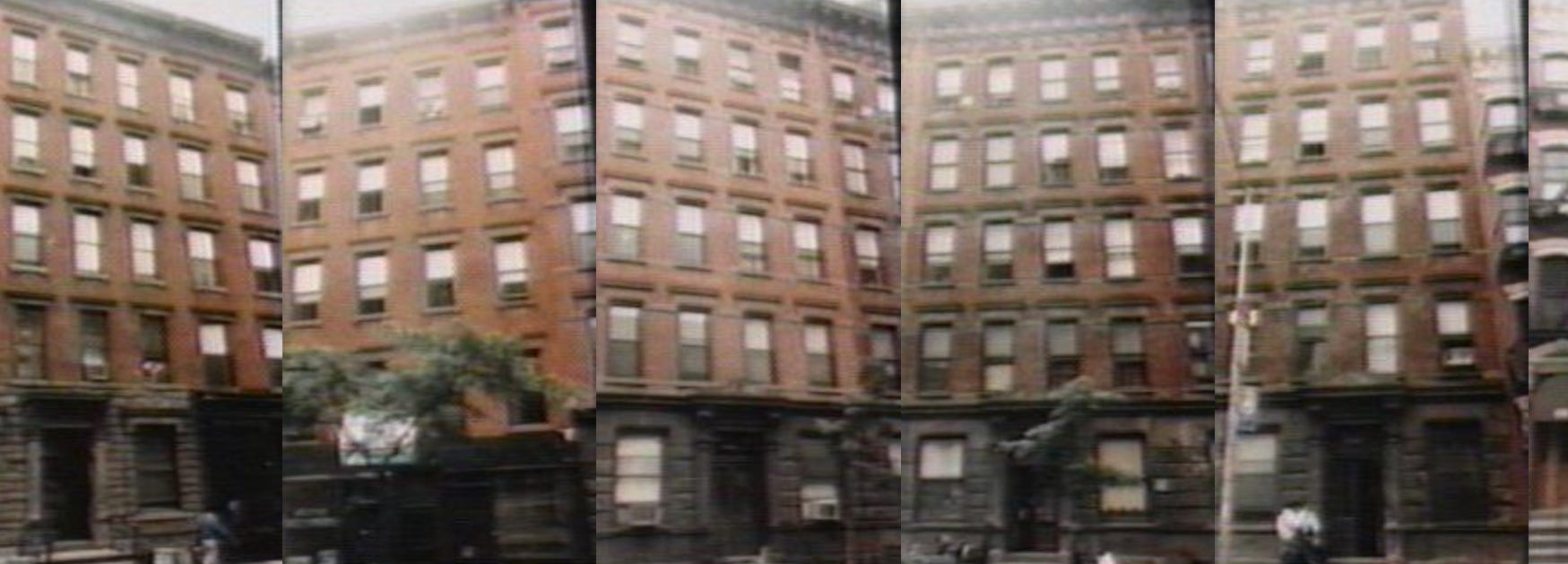
After imposing on Dina and her mom for too long, I’d moved into my friend Ray’s apartment on 50th street between 9th and 10th Avenue. Ray was another alum from the junior year abroad program in Greece. His apartment was in the neighborhood of “Hell’s Kitchen” and in the 80s it certainly looked the part. Homeless people slept along the sidewalks, graffiti and boarded up windows covered the buildings, barbed wire rolled along the tops of walls like post-apocalyptic Slinkies. But that was true of all of New York at the time. 1980s New York was still basically 1970s Serpico New York. Or think Taxi Driver, The French Connection, Dog Day Afternoon, or Midnight Cowboy. It wasn’t until David Dinkins became mayor in 1990 that the city started to clean up, and it wasn’t until Rudy Giuliani that the effects became visible enough for the sitting mayor to get credit for it.2 Some lament the disappearance of the grittier New York, but as Carl might put it, they are f*cking idiots.
Ray’s building on rent strike, so the exterior door was rarely locked, and people slept in the hallways, and there was a crack dealer one on the third floor. Ray’s apartment was on the fourth-floor. It was a “shotgun layout” painted in a garish purple and green by someone who’d hoped it might be whimsical. To the right of the narrow front door was the living room/bedroom with a futon couch, usually open, (First time I’d ever heard of a futon!) beneath a single, dangling pull-string bare-bulb light. The only furniture was an old-fashioned wooden desk like something from a 19th century school. A mirror on it leaned against the wall. When Ray was staying with his girlfriend in the Village—and he usually was—I would sit and look in the mirror and play guitar or write songs until late and then sleep on the futon.
Dividing the living room/bedroom from the kitchen was a carved-out water closet—literally a closet with a pull-chain toilet beneath an overhead tank that had to be filled with a spigot between each use. The kitchen was also the rest of the bathroom with a bathtub on a raised platform, a gas stove on a slanted floor, and another dangling, pull-string bare-bulb light hanging from the peeling ceiling. Beyond the kitchen was another door leading to a pitch-black back room with no light or electrical outlets. This was technically my room but I never set foot in it except to stash my money in a space behind a wardrobe and on the rare nights when Ray wasn’t in the village creep in to sleep on a piece of foam that I’d bought in Chinatown. I stashed a lot of money because since the building was on rent strike there was no rent. No utilities either, though I don’t know why the electricity wasn’t cut off.
Nights
Outside of work I would sometimes hang out with Ray in the Village or with Dina or with other friends from Greece, but mostly I walked the neighborhood. I might eat at Munson’s Diner on 11th Avenue late when it was filled with cab drivers and prostitutes, but I wouldn’t talk to anyone. I just watched and listened. There was a dishwasher the others made fun of because it riled him up and a boisterous cook who once held a contest rolling muffins down the middle of the restaurant floor. I can’t remember why. The muffins were often moldy on the bottom so maybe they were about to throw them out.
Sometimes I’d sit in a bar somewhere and I would talk to people then. Though I never found a favorite bar. I once sat next to a guy at a tiny place somewhere along 8th Avenue who said he’d lived for awhile in California where he’d installed Jerry Garcia’s basement stereo system. He said Garcia was nice but smelled really bad and just sat in the basement freebasing. This wasn’t reported in a mean or gossipy way; it was more a tsk-tsk musing on the futility of fortune and fame. How could even Jerry Garcia end up freebasing in the basement? Whenever I heard something like this I had to think about it, and I couldn’t think sitting next to anyone, so I would pay my tab, leave and go walk around the city thinking about whatever I’d seen or heard. I’d tell myself this was good because by leaving I was saving more cash to hide in the backroom stash.
Sometimes I’d find myself on Broadway and I’d thumb through the sheet music at Colony House or the albums at Tower Records. Or I’d wander looking for something to eat. Often I couldn’t decide what to buy, so I wouldn’t buy anything, or in the food case, I wouldn’t eat anything. More cash to save.
I was never particularly scared walking around at night. I’ve always been very vigilant about my surroundings and willing to cross the street or change course if I had any sense of unpleasantness in the way ahead. Making a phone call was scarier to me than walking the streets of NY at night. Probably because I never quite felt that it was me walking around, so whatever happened it wouldn’t be happening to me.
Usually, after many blocks I’d find myself back at Ray’s apartment. I’d sit in the one chair, face the mirror, and play guitar or write songs. I’d only been learning the guitar for about a year, so I was in that exciting phase of discovering chords and progressions. As for writing, my songs were good, but basically they were in the style of others: especially John Prine, Johnny Cash, Waylon Jennings, and Bruce Springsteen—with a little Pink Anderson thrown in. They were emotionally true (I think) but the details were never about the life I was actually living or the people I was actually meeting. They were about my past or imagined future or an alternative reality in which I was a drinker not a brooder, a troublemaker not a ghost. A couple of times I played my songs at open mics—but felt mostly nervous and awkward about it. Who am I to play songs? Who cares what I do?
Days
So life was mostly at work. The fall gave way to winter. We were in a gutted building somewhere and there were two new employees. There was a new laborer, a Puerto Rican guy named Carlos—a young college kid like me. I liked him a lot but we weren’t on the same jobs very often.


There was a chunky middle-aged Irish-American carpenter whose name so eludes me that I can’t even come up with a plausible fake one. He loved the Irish-American Carpenter’s Union and wore a dark blue Irish-American Carpenter’s Union t-shirt and an Irish-American Carpenter’s Union hat. And although he currently did not have a union job in the Irish-American Carpenter’s Union, he liked me immediately and promised he could get me one such job. He asked me to cut a board to show my stuff. I did and he praised me and told me the glories of the Irish-American Carpenter’s Union which was quite different and much better than the Irish-American Laborer’s Union. He would get me a job building forms to pour concrete on one of the large towers, and the others would cover for me for a few weeks while I learned to do the job. I told him that seemed unfair to the guys in the Irish-American Laborer’s Union. Shouldn’t they get the training so they could move up? He said I didn’t understand. No one ever went from one to the other. I told him I wasn’t sure I was Irish and he said I was probably Irish somewhere back. Out of curiosity alone I was game for the Irish-American Carpenter’s Union—I knew from Bruce Springsteen songs that union jobs were good—but when I went back to Virginia for a few days around Christmas, I returned to find he was gone. I suspect Carl got him fired.
I know Carl got Carlos fired. When I got to work Carl told me he wanted to kneel down and kiss my ass he was so glad I was back. Carlos had had the misfortune of being Carl’s helper when I was gone. Carl half-complained, half-bragged—and this was confirmed by Jimmy and Bryan—that he’d reduced Carlos to tears in only two days. “He was a f*cking idiot.” At that point they boosted my pay to $7.50/hour.
Because of more recent stereotypes and cultural patterns you might imagine Carl as racist and his appreciation of me as motivated by mutual whiteness. But that wasn’t true at the time. Today Carl might have evolved into MAGA racist harrumphing about the latest Fox News outrage, but despite being a bad person, back in the day Carl’s animus never took a racial dimension. He certainly respected Rudy more than me.
Rudy was a better person but he was grouchy too. Remember that before You Tube videos or even cellphones to call a friend or family member for advice, work crews had to figure out what they were doing on their own. Jimmy had it easier because tiling is tiling, but Rudy and Carl, despite being called carpenters mostly did not do woodwork. Carl and I built a wall with glass bricks, cast a plaster arch, hung sheetrock, taped sheetrock, installed electronic sensors, and a lot more. Carl and Rudy were under incredible pressure to figure out how to do all this, and Carl was extremely high-strung and I calmed him, so he was right to appreciate me.
Still Carl was a bully. I remember Dina came to visit us at a site in Midtown and Carl made a point of ordering me in front of Dina to scrub some rustic floor tiles while they went to lunch. Dina winced. I didn’t care. Like walking around at night I never felt like it was me working anyway.
The buildings fascinated me as much as the people. Not the style and decorations but their inner workings. We entered through service elevators that met tunnels and gray service hallways snaking through the backstage of New York luxury. In these spaces were locking cages of supplies and mop buckets, service sinks and switch panels, mismatched chairs, stools, and benches, garbage carts left mid-job to answer some call, card tables with tabloids and boom boxes and chattering walkie talkies. Everyone in the service world in their jumpsuits, overalls, and uniforms were friendly and knowledgeable, they were our peers, but we never lingered in these spaces. We passed through to reach whatever apartment or office we were working on, and passed through again on the way home. Three cultures intersected: the apartment residents, the building managers, and the work crews.
Hugh
I was at a site on the Upper East Side when Hugh brought Pete and Gray/Greg to load up the van with all the trash, and then he even took Todd and me along. Rudy and Carl were never happy to have their helpers taken so this was a big deal. We were jammed into this van full of trash and Hugh drove us several blocks uptown and turned right and ahead we saw a building covered in scaffolding with a construction dumpster—an open rectangle the length of two cars—in the street.
“When I pull up we’ve gotta unload everything as quick as possible!”
The light changed. Hugh sped up and then slammed on the breaks with the right rear of the van just past the front left of the dumpster. He shifted the van into park and hit the hazard lights as we all jumped out opening all the van doors and frantically hurled scrap piles and upturned trashcans into the dumpster. We heard shouts from above and a shout from up the block as the dumpster’s owners realized our transgression.
“Come on!” Hugh called as he was already slamming the driver door. We flung some final trash, dove in, and peeled out with the doors flapping and sliding. Hugh swerved onto Park Avenue, as a dozen angry construction workers chased us cursing and flinging cans half a block.
That was the last time I saw Hugh.
A week later David came into the site. This was unusual. For once David looked not dour but stricken, as if his long suspicions of inevitable doom had finally been proven true, and he didn’t like being right.
David said Hugh was dead. He had died on his motorcycle. Not speeding 80mph on a glorious rural highway, but idling at an intersection in the city waiting for a light to change when a taxi clipped him while trying to make a turn.
The End
After that, the job was a lot less fun. David replaced Hugh as the person who brought things and took things and gave us checks. I came to really like David and respect all he had on his shoulders. Running a construction company is very hard. Current clients have to be kept happy while new clients have to be recruited, while all the different employees and crews have to be kept busy. But David wasn’t easygoing so he added stress.
One day I was using a miter saw. That’s a platform waist high with a back guard and a saw on a hinge. A piece of wood is put up against the guard and the saw brought down to quickly and cleanly cut a very even angle. The saw can be adjusted too, so these tools are used especially for installing molding and trim.
I was cutting a section of baseboard and a triangle of wood broke and got caught in the saw’s teeth. Somehow this pulled my hand toward the blade but then in a split second the triangle shot back out knocking my hand away. It hit the flesh between my thumb in my index finger with so much force that my entire hand went numb, and I realized that if the piece hadn’t shot out the saw would have mauled my hand. I could’ve lost a finger or my thumb. I realized I wouldn’t be able to play the guitar. I realized my half my hand was numb so I couldn’t play the guitar now.
David was at the site and asked what was wrong. I told him I’d almost cut my hand, and anyway it was numb. David folded his arms, irritated. Carl came in and asked what was wrong. I told him I’d almost cut my hand, and anyway it was numb. Carl sighed, shook his head, and went back into the other room.
I went home which neither David nor Carl liked at all. Sure enough, I couldn’t play the guitar. I couldn’t feel where my hand was. I took the next day off; the feeling in my hand started to return. I went back the next day but no one was sympathetic; I wouldn’t have been either if someone took off a day and a half because their hand was numb. But I didn’t care. I suddenly felt like it was actually me working, and I liked the job and some of the people, but I wondered what I was doing in New York.
Then one day in the spring when the weather was better, I was coming home and in the hall steps and a guy asked me if I lived in the building. He was wearing a Member’s Only jacket and carrying a notepad. He had curly hair and a glass eye or a lazy eye; the hallway was too dark to know which. He noticed my hesitation, and said in a very friendly way that he was the new building manager. He wanted to get to know all the tenants. The new owners were aware of the problems in the building, and they wanted to let people know personally that they were resolving everything. The woman whose name was on the lease had moved to Boston, and she was basically holding out for a financial settlement. So Ray was subletting from her which was sort of legit, but me subletting from Ray was not, since no one had a lease, so I grimaced.
“I’m Ray,” I said, shaking his hand. Being in a building on rent strike had been very funny, but lying felt awful. But I had to lie so Ray wouldn’t get in trouble for letting me stay there.
The building manager showed me some of their plans, showed me the other building, asked me a few questions that I answered as vaguely as possible. The nicer he was the worse I felt.
Then a week after that, by which time I was generally petulant and prickly, I had a squabble with Ray about something that had nothing to do with the job. It was all my fault but it really brought home how mediocre I felt I was as a human. Just unable to be honest or real.3 I need to leave New York. I had a lot of money saved. I could go to Charlottesville, maybe buy a van and see the country, or move to Nashville and try to be a songwriter.
I gave my notice at work and left New York. Carl was angry and refused to wish me well. I’m sure that as soon as I left, he called me a “f*cking idiot.” David folded his arms and frowned, but said, “I’m sure you’ll figure things out.” The Irish tilers said since it was my last day, I was supposed to buy everyone drinks, which I guess is an Irish tradition, but I was too cheap for that. So at the end of the day I left, and left New York the next day on a train.
After the End
In Charlottesville, I didn’t buy a van or go to Nashville. Instead I almost immediately got another construction job. Which is another story.
Years later when I lived in New York again (and briefly worked a third construction job) I tried to find some of the buildings I worked on. I have clear maps of these places in my mind, but when I walked through the neighborhoods those maps never fit the actual spaces around me. The maps just float like ghosts; I don’t know how to orient them or where they fit.
I think of Carl whenever I’m using wood glue. I’ve been working this weekend on trimming out some French doors and trying to get wood glue distributed properly without it dripping on the floor always calls to mind Carl jauntily spreading glue with his fingers and wiping them on his overalls. For all his faults anyone who can spread glue evenly is worthy of respect.
My favorite NYC movie by the way—and the movie which most calls to mind the New York of that period—is not any of those grimy crime thrillers. Those films are the city that people feared. For the city that people loved I recommend you watch Moscow on the Hudson. That captures the immigrant city that I experienced better than all the crime movies.4
Thanks for reading Blame Cannon! I’ve been so distracted by the war that I’m behind on my other posts. This week I’m working on the next chapter of the journeys of John Lederer.
Comments are welcome but please no personal insults or profanity, so I can set a good example in case my daughter reads this.
The only motorcycle enthusiasts I’d known were “bikers” in Charleston and Daytona Beach who rode Harley Davidsons, wore black leather, and hated helmets, so it was shocking to me that Hugh liked helmets.
We’re behind on our other cycles of stories, but the cause of NYC’s decline was the postwar federal subsidizing of suburban subdivisions. We’ll be getting to that soon in our suburbs series. Builders could get loans to construct single-family homes in the suburbs but could not get loans to remodel urban buildings; white heads of household in the 50s and 60s could get cheap mortgages to buy those homes, but could not get rent support or money to buy urban apartments. So people moved to the suburbs. Taxes fell and like America’s elite today, the NYC elite simply failed to adjust to the new reality. They kept doing what they’d always done with the expectation that it would work because it always had. By the 70s the city was bankrupt and had to surrender itself to the state in order to get loans. The state cut services, which left the city a mess. For how it made a comeback check out Thomas Dyja’s New York New York New York.
Also it’s Robin William’s best performance IMO, and it’s one of the few movies with a believable love story, and plausible account of working class life.